
The Current State of Tweed
My father’s tweed credo was, “If it doesn’t make you sweat, it’s not a good sport coat.” The lovat jacket he gave me to wear at prep school, like my friend’s Norfolk jacket, would be too heavy to sell in most retail stores today, except to old-fashion aficionados of the Natural Shoulder look, or maybe at stores inside the Arctic Circle or in Antarctica. It seems that Ben Silver of Charleston sells a lot of Harris Tweed from their catalog; no doubt because most brick-and-mortar retailers are heavy-phobic, wise enough to be afraid to make the investment.
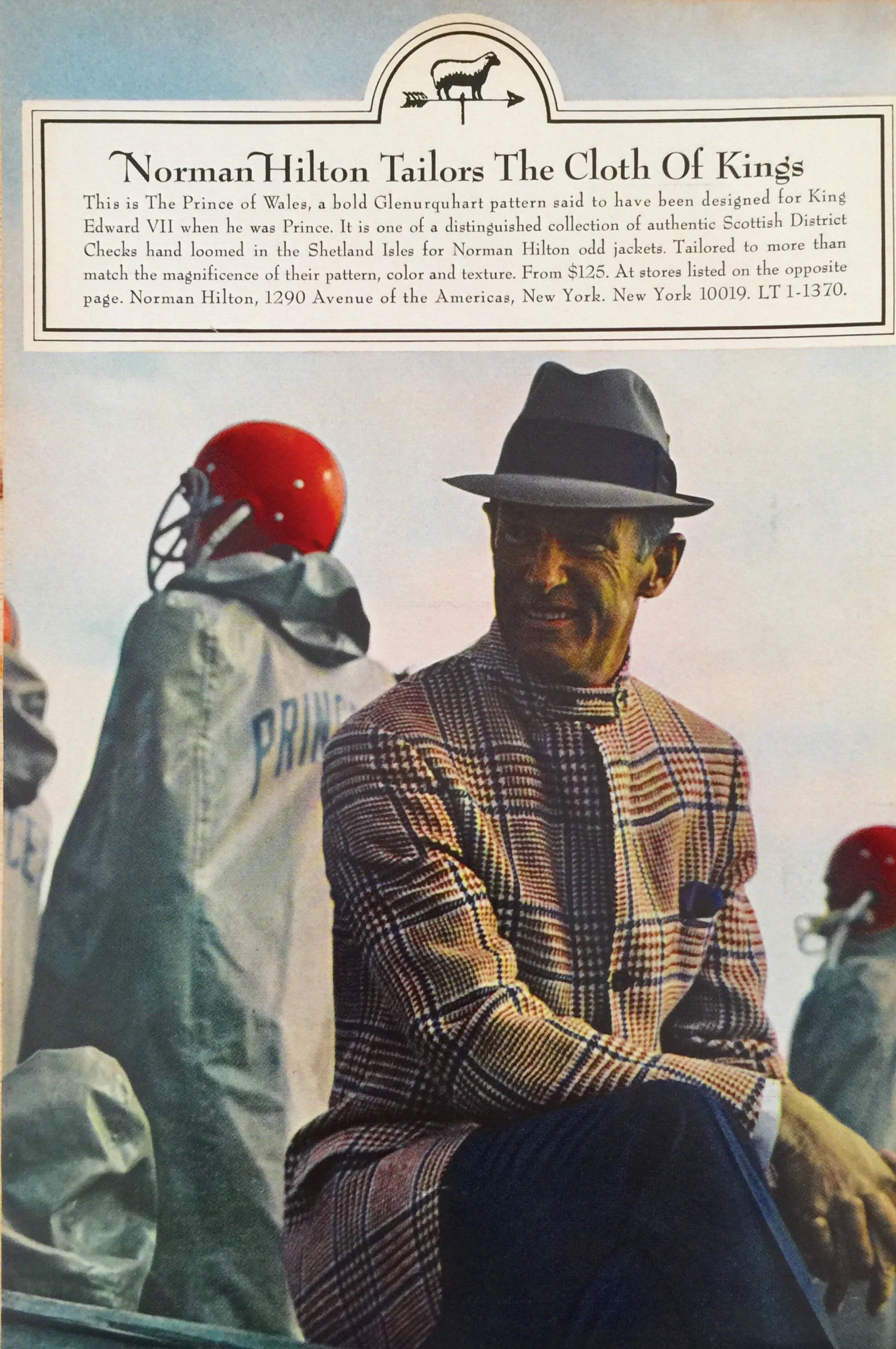
If people’s choice of cloth by weight is any indication, the world must be getting warmer. The average weight of a fall/winter jacket fabric when I was first in the business, around 1970, was 14 or 15 ounces to the yard. It means that a length of cloth, 60 inches wide (that’s how wide the looms usually are) by 36 inches long, that is, one running yard, weighed 14.5 ounces or so. The fabric in a sport coat – just the fabric – weighed about 2 and a half pounds, give or take. Sport jackets most commonly sold today are made of cloth that weighs at most 9 to 10 ounces. This means that just the fabric in the jacket weighs one pound less. It may not sound like much, but try carrying an extra pound around all day. Or, said another way, a sport coat today is one-third less heavy. The Merino wool farmers in Australia and New Zealand have cross-bred and hybridized their flocks to insure the finest, longest staple fleece. And the Italian cloth-finishing techniques, the spinning processes and the sophisticated machinery for weaving make possible jacket fabrics that are as comfortable as pajamas. When it came to comfort the cloth makers who aimed to remain in business, particularly the Italians, knew that soft finishes and gossamer weights were essential. Today, the relatively few bolts of Harris Tweed still loomed in the Outer Hebrides weigh far less than they once did. Trouble is, they are still so much heavier and rougher to the touch, comparatively, than the sport coat fabrics from Italy that the British cloth mills are mostly just a memory.
But what a memory! When I first went to Scotland and Ireland, after joining the business in 1970, I went to all the tweed mills in the Borders District, between Edinburgh and the English border. The towns were called Peebles, Galashiels, Hawick, Selkirk. I visited some up in the north and the Highlands as well. I also went every summer to Donegal Town, on the west coast of Ireland, home of Magee & Company, Ltd. and their famous Donegal Tweeds. I liked to design my own styles for our line. The creativity it called for, and the fascination I had with color, pattern and texture, made me love the work, and enabled me to imagine it as a true calling and a lifelong career. In these two-week styling trips I fell absolutely in love with the textile industry and the real blending of art and commerce the field represented. The mill designers loved their craft, and they were generous with their time and proud of their products, giving a young upstart an education he’d never forget, and offering exclusivity in design and sometimes of an entire fabric range, that made my line unique and gave us a definite competitive advantage.
The Brits by now have pretty much bought the farm as far as textiles are concerned. One story alone kind of tells the tale. One day I was in the design office of a firm called Gardiner’s of Selkirk visiting Murray Tait, the company’s designer and stylist, working on my Fall collection, to be delivered into stores a year or so later. On a side table by the door I found an end of cloth and I picked it up. By the standards of the 1970’s it was practically weightless.
“What is this, Murray?” I remember asking.
“Ohch. That’s a useless ould thing,” Murray said in his pleasant way. “We cannae sell it. The IWS woun’t gi’ us the approval of it.”
“The what?”
“The International Wooool Secretariat,” he said. “Say it’s too bloody light in weight. Won’t hold up.”
It was the first “light-weight” tweed I’d ever seen. Heavy by todays standards, but unique at the time. It became the Norman Hilton Castlereagh jacket, the best-selling sport coat fabric of all time. In one season we sold over 2500 sport jackets of this one cloth, a huge number at our prices. It was revolutionary; and it was ours exclusively. The cheaper guys, always barking at our heels, were helping us by telling their customers “I got the same thing as Hilton, but for less.” It wasn’t the same thing at all, and their false boasts just made our product more desirable. Thank goodness for the high standards of the IWS.
All these years later, there’s still a mill in the Borders making tweeds. They’re called Lovat Mill. The closest thing to our old Castlereagh cloth is called “Teviot” — named for a nearby river, of course. We offer it today in the original style of the Norman Hilton jacket: three-button, tip-over front with stitched edges and a hook-vent, made exclusively for us in Rochester, New York, USA. We are celebrating all the standout things about the family legacy in this the 25th year of this chapter in the Hilton family legacy.